CORP PLACE GLOBAL | INSIGHTS
India's DPDP Moment: Are Businesses Turning Privacy Rules into Real Readiness?
Data Protection | Regulatory Readiness
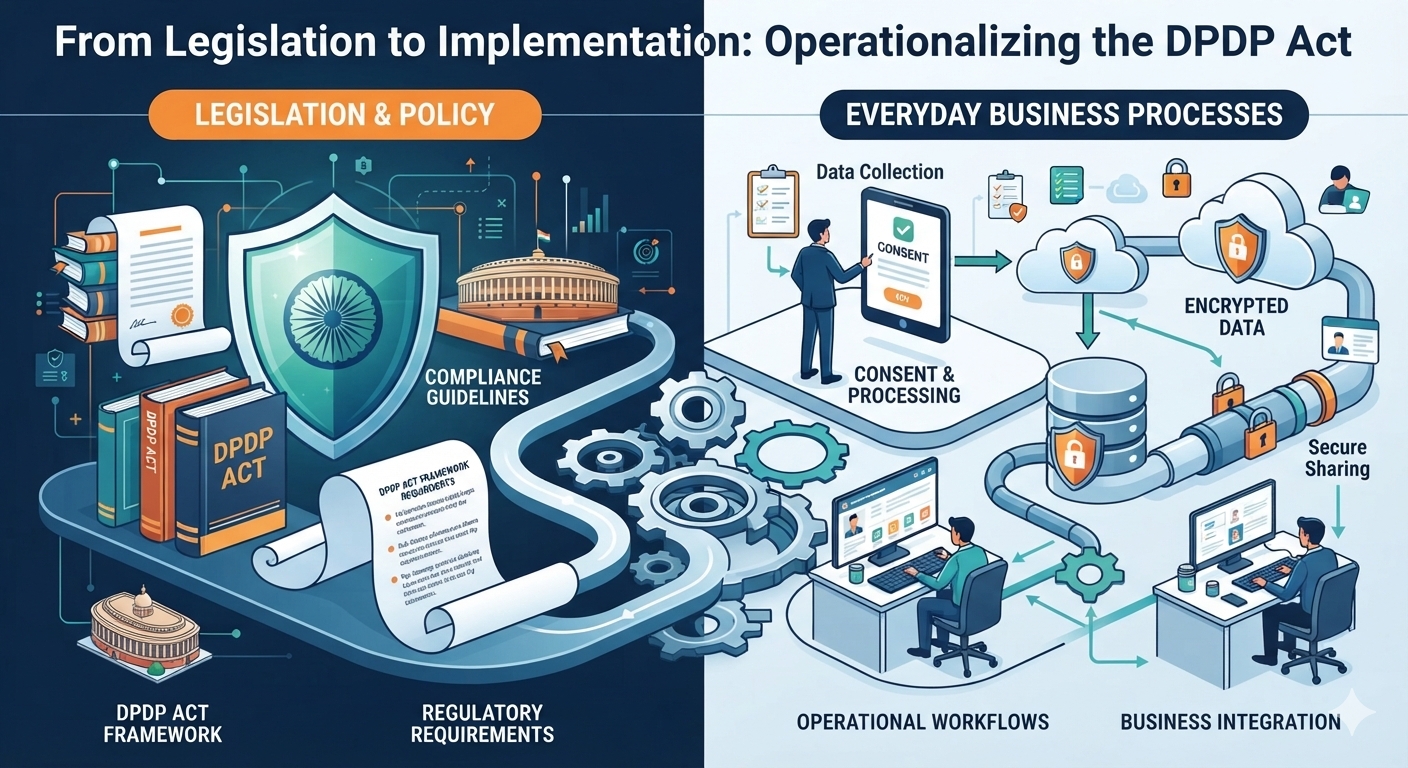
India's data protection framework is moving from legislation to implementation. Yet the biggest challenge for businesses may not be understanding the law, it may be changing the everyday processes through which personal data is collected, used and shared.
Privacy is now a business issue, not just an IT issue
Think about how much personal information a business handles in an ordinary working day: a job applicant's CV, an employee's bank details, a customer's contact information, a visitor log, or details entered into an online form. That information moves between teams, software platforms and service providers, often without anyone having a complete picture of where it goes or how long it stays there.
That is the practical challenge behind India's Digital Personal Data Protection Act, 2023 (DPDP Act) and the Digital Personal Data Protection Rules, 2025 (DPDP Rules). Together, they set out a framework for handling digital personal data more responsibly and give individuals clearer rights over information relating to them. For businesses, privacy can no longer sit only in a policy document. It needs to be reflected in daily decisions, systems and contracts.
What has changed under the DPDP framework?
The framework places responsibility on a Data Fiduciary the organization that decides why and how personal data is processed. A Data Processor may handle that information on the organisation's behalf, but using an outside vendor does not remove the Data Fiduciary's accountability.
In practical terms, organisations need to be able to explain why they collect personal data, give individuals clear information about that use, rely on a valid basis for processing, protect the information with reasonable safeguards, respond to requests from individuals, manage breaches and delete data when it is no longer required, subject to legal retention requirements. The framework also addresses children's data and the responsibilities of significant data fiduciaries.
Why are organisations finding implementation difficult?
The reasons are familiar to anyone who has worked on a compliance project. Personal data is spread across HR, sales, customer service, finance, marketing and technology systems. Some records sit in structured databases; others are buried in email, shared drives, spreadsheets and vendor platforms. Teams may understand their own processes but lack a common view of the full data journey.
Our research also points to difficulty interpreting the requirements, limited budgets, gaps in specialist expertise and challenges with privacy technology and cross-border data flows. In many organisations, legal or IT teams may understand the subject, while the business teams that collect and use personal data have not yet received enough practical guidance.
The timeline: why waiting is a risky strategy
The Rules provide for phased commencement. The one-year stage, which includes Rule 4, falls in November 2026. The main set of operational rules - Rules 3 and 5 to 16, along with Rules 22 and 23, is scheduled to commence eighteen months after publication, in May 2027. The corresponding core provisions of the Act are also scheduled for the eighteen-month stage. Organisations should verify the exact applicable dates and any subsequent official notifications before relying on a timeline for a particular obligation.
A transition period may look generous on paper. In practice, mapping data, reviewing notices and consent journeys, renegotiating vendor arrangements, updating systems, training employees and testing breach-response procedures can take months. The work is cross-functional; it rarely sits with one department.
A practical starting point for businesses
A useful first step is not to buy a new privacy platform or rewrite every policy at once. It is to understand the organisation's current position. Businesses can begin with a focused readiness exercise:
Map the data: Identify what personal data is collected, why it is used, where it is stored, who can access it and when it is deleted.
Review notices and consent: Check whether privacy notices explain the purpose of collection clearly and whether consent journeys work as intended.
Know your vendors: Identify processors and other third parties that handle personal data; review contracts, safeguards and oversight arrangements.
Prepare for individual requests: Create a clear process to receive, verify, track and respond to requests for access, correction, erasure and grievances, as applicable.
Strengthen security and breach response: Review access controls, retention, security safeguards, incident escalation and breach communication procedures.
Bring employees into the process: Train HR, sales, marketing, finance, operations and customer-facing teams on the data they handle and the decisions they make.
From compliance deadline to customer confidence
The DPDP framework will require effort, but it also gives businesses a reason to take a closer look at how they handle information. Clearer data practices can reduce unnecessary collection, improve vendor discipline, strengthen internal accountability and make customers and employees more confident about sharing information.
The organisations that make meaningful progress will not necessarily be those with the longest privacy policy. They will be the ones that can explain what data they hold, why they need it, who uses it, how it is protected and what happens when an individual asks a question or something goes wrong.
HOW CORP PLACE GLOBAL CAN SUPPORT YOUR DPDP READINESS
A successful DPDP compliance programme requires more than understanding the law. Organisations need to assess their existing practices, identify gaps and implement appropriate policies, processes and controls.
Corp Place Global can support organisations through the following services:
🔍 1. DPDP Readiness Assessment
Evaluate your organisation's existing data protection practices, understand its current level of preparedness and identify areas requiring attention.
🗺️ 2. Personal Data Mapping
Identify what personal data your organisation collects, where it is stored, how it is processed, with whom it is shared and how long it is retained.
⚠️ 3. Gap Identification & Compliance Assessment
Assess existing practices against applicable DPDP requirements, identify compliance gaps and highlight areas where corrective action is needed.
📄 4. Policy Drafting & Review
Develop or review key policies and documents, including privacy notices, data protection policies, consent-related documents, data retention policies and internal procedures.
⚙️ 5. Process & Control Implementation
Assist in establishing practical procedures and controls for consent management, data principal requests, personal data security, data breach management and data retention.
🤝 6. Third-Party & Vendor Assessment
Review how external vendors and service providers handle personal data and assess whether appropriate contractual safeguards and oversight mechanisms are in place.
🏢 7. Data Protection Governance
Support organisations in defining roles, responsibilities, accountability mechanisms and internal reporting structures for effective data protection management.
🎓 8. Employee Awareness & Training
Conduct awareness sessions to help employees understand their responsibilities, handle personal data appropriately and follow the organisation's data protection practices.
Connect with us to explore the resources and guidance available to strengthen your organisation's compliance practices.
Author: Vaishnavi
Legal And Compliance Executive









 29th Apr 2025
 4th May 2025
 4th May 2025
 4th May 2025
 15th Sep 2026
 4th May 2025